Skip to content
  • Categories
  • Recent
  • Tags
  • Popular
  • Users
  • Groups
Skins
  • Light
  • Brite
  • Cerulean
  • Cosmo
  • Flatly
  • Journal
  • Litera
  • Lumen
  • Lux
  • Materia
  • Minty
  • Morph
  • Pulse
  • Sandstone
  • Simplex
  • Sketchy
  • Spacelab
  • United
  • Yeti
  • Zephyr
  • Dark
  • Cyborg
  • Darkly
  • Quartz
  • Slate
  • Solar
  • Superhero
  • Vapor

  • Default (No Skin)
  • No Skin
Collapse

BeME Community

Blogs Get Apps
D

dylanjackson783

@dylanjackson783
Unfollow Follow
About
Posts
6
Topics
6
Shares
0
Groups
0
Followers
0
Following
0

Posts

Recent Best Controversial

  • We Buy Houses in Manhattan Beach: A Guide to Off-Market Private Sales
    D dylanjackson783

    Not every home sale needs to go through a public listing. In a market as tight and high-demand as Manhattan Beach, more homeowners are discovering the benefits of selling privately, off-market, directly to a buyer who's ready to close — without photographers, open houses, or months of uncertainty.
    If you've come across companies advertising "we buy houses Manhattan Beach" and wondered how the process actually works, this guide breaks down what an off-market private sale looks like, who it's best suited for, and what to look for in a legitimate buyer.

    What Is an Off-Market Sale?

    An off-market, or "private," sale simply means a property is sold without being listed on the MLS (Multiple Listing Service) or exposed to the general public. Instead of marketing the home broadly, the seller works directly with a single buyer — often an investment company, builder, or individual investor — to negotiate a sale privately from start to finish.
    This approach has existed for as long as real estate itself, but it's become increasingly common as sellers look for faster, more private alternatives to the traditional listing process.

    Why Homeowners Choose to Sell Off-Market

    Privacy

    An off-market sale means no public listing, no photos circulating online, and no strangers walking through your home during an open house. For many Manhattan Beach homeowners, particularly those with high-value or high-profile properties, this discretion is a major draw.

    Speed

    Without the need to prepare a home for public showings, coordinate a marketing campaign, or wait through a traditional negotiation and financing period, off-market sales can move significantly faster — often closing in a matter of weeks.

    Certainty

    Traditional listings can fall through due to buyer financing issues, appraisal gaps, or cold feet during a long escrow period. A direct, off-market sale to a cash buyer removes many of these risk points, giving sellers far more certainty that the deal will actually close.

    No Repairs or Preparation

    Homeowners who sell your house through an off-market process typically sell as-is, without investing in repairs, staging, or cosmetic updates aimed at attracting public buyers.

    Flexibility on Timing

    Whether you need to close quickly or want more time to coordinate a move, off-market sales are generally far more flexible than a listing tied to market activity and buyer availability.

    Who Benefits Most From Selling Off-Market

    • Homeowners relocating quickly for work or personal reasons
    • Owners of properties needing significant repairs that would be difficult to sell traditionally
    • Sellers who inherited a property and want a straightforward, low-hassle transaction
    • Landlords with tenant-occupied properties, since off-market buyers are often comfortable purchasing with a lease in place
    • Homeowners who simply value privacy over maximizing exposure through a public listing
    • Anyone who wants to sell my home without the disruption of showings, marketing, and an extended timeline

    How the Off-Market Process Typically Works

    1. Initial Contact and Property Details

    The process usually starts with a conversation about the property — location, condition, and your goals for the sale.

    2. Property Evaluation

    Rather than a series of public showings, a single walkthrough (or in some cases, a remote assessment) is used to evaluate the home's condition and value.

    3. A Direct, Written Offer

    Based on the property's condition and current market data, you receive a clear offer with no hidden contingencies. This is often when sellers realize just how much simpler this path is compared to a traditional listing.

    4. Flexible Closing

    Once the offer is accepted, closing can typically happen on whatever timeline works best for you, whether that's two weeks or two months out.

    What to Look for in a Legitimate Off-Market Buyer

    Because off-market transactions don't go through the same public process as a traditional sale, it's especially important to vet who you're working with. Look for:

    • Verifiable proof of funds, confirming the buyer can actually close without financing
    • A track record of completed transactions in your specific market
    • Transparent offer calculations, so you understand exactly how a number was reached
    • No pressure tactics or artificially short deadlines designed to rush your decision
    • Clear, written terms for every part of the transaction, from offer to closing

    If you're evaluating options to sell your house for cash, taking the time to confirm these details upfront protects you from less reputable buyers who sometimes operate in this space.

    How Reeland Investments Approaches Off-Market Sales

    At Reeland Investments, our process is built specifically around the homeowners who reach out because they've seen "we buy houses Manhattan Beach" and want to understand what that actually means in practice. We provide clear, written offers based on real market data, verifiable proof of funds, and a straightforward closing process with no last-minute surprises.
    Whether you're trying to sale my house quickly due to a time-sensitive situation, or you simply prefer the privacy and certainty of an off-market transaction, our team works directly with you from the first conversation through closing, without the friction of a traditional listing process.

    Final Thoughts

    Off-market sales have become a genuinely practical option for Manhattan Beach homeowners who value speed, privacy, and certainty over the traditional listing process. Done correctly, with a transparent and reputable buyer, this approach can be one of the simplest ways to sell a home in one of the South Bay's most competitive markets.
    If you're considering an off-market sale and want a straightforward, no-obligation offer for your Manhattan Beach property, Reeland Investments is happy to walk you through the process.

    General Discussion

  • Buying a New Construction Home Before Completion in Manhattan Beach
    D dylanjackson783

    In a market as competitive as Manhattan Beach, some of the best opportunities never make it to a traditional listing at all. Buying before a home is finished — sometimes even before the foundation is poured — has become an increasingly popular strategy among buyers looking to secure new construction homes for sale in Manhattan Beach on their own terms, rather than competing for a finished product on the open market.

    If you're considering this approach, here's what to know about the process, the advantages, and the potential risks before you commit.

    Why Buyers Are Purchasing Before Completion

    1. More Customization Control

    Buying early in the construction process — sometimes referred to as buying "pre-sale" or "off-plan" — often allows buyers to select finishes, fixtures, and in some cases even minor layout adjustments. This level of input simply isn't available once a home is fully built and listed.

    2. First Access to Limited Inventory

    Manhattan Beach has limited buildable lots, and desirable new construction homes in Manhattan Beach often attract multiple offers the moment they hit the market. Buying before completion allows buyers to secure a property early, before competition drives up the price or the home sells to someone else entirely.

    3. Potential Price Advantages

    In some cases, builders offer more favorable pricing to early buyers to help fund ongoing construction or generate early momentum for a project. While this isn't guaranteed, it can represent a meaningful opportunity for buyers willing to commit before a home is fully finished.

    4. More Time to Plan

    Purchasing before completion gives buyers additional lead time to plan financing, coordinate a move, or sell an existing property — rather than needing to move quickly once a completed home hits the market.

    What to Understand Before You Buy Pre-Completion

    Builder Reputation Is Everything

    When you buy before a home is finished, you're placing significant trust in the builder to deliver on quality, timeline, and design as promised. Researching a builder's history with other new construction homes for sale Manhattan Beach projects — including reviews, completed work, and reputation for staying on schedule — is critical before signing anything.

    Contracts and Deposit Structure

    Pre-completion purchases typically involve deposit schedules tied to construction milestones. It's essential to understand exactly what you're committing to, including cancellation terms, what happens in the event of construction delays, and how change orders or upgrades are priced.

    Financing Considerations

    Financing a home that isn't yet complete can work differently than a standard mortgage on an existing property. Buyers should coordinate early with a lender experienced in new construction financing to understand timing, appraisal requirements, and any construction-to-permanent loan options available.

    Timeline Uncertainty

    Even with an experienced builder, construction timelines can shift due to permitting delays, weather, or material availability. Buyers should build flexibility into their own plans rather than assuming a fixed move-in date.

    Is Buying Before Completion Right for You?

    This approach tends to work best for buyers who:

    • Have flexibility in their timeline and current living situation
    • Want more input into finishes and design details
    • Are working with a builder who has a strong, verifiable track record
    • Understand and are comfortable with the inherent risks of pre-completion purchases

    For buyers ready to buy new construction homes in Manhattan Beach ahead of completion, having experienced guidance through the process is essential — both to evaluate the builder and to negotiate favorable terms.

    How Reeland Investments Can Help

    At Reeland Investments, we help buyers evaluate pre-completion opportunities throughout Manhattan Beach, from vetting builder reputation to understanding contract terms and financing options. Our goal is to help you take advantage of early-access opportunities without taking on unnecessary risk.

    If you're exploring new construction homes in Manhattan Beach developers are currently building, or want to understand whether buying before completion makes sense for your situation, Reeland Investments can walk you through the process and help you make a confident, well-informed decision.

    Final Thoughts

    Buying a new construction home before it's completed can offer real advantages — more customization, earlier access to limited inventory, and additional planning time — but it also requires careful due diligence on the builder and a clear understanding of the contract terms involved.

    If you're considering this path, reach out to the team at Reeland Investments to get expert guidance before you commit.

    General Discussion

  • Teardown vs. Turnkey: What Actually Drives Home Value
    D dylanjackson783

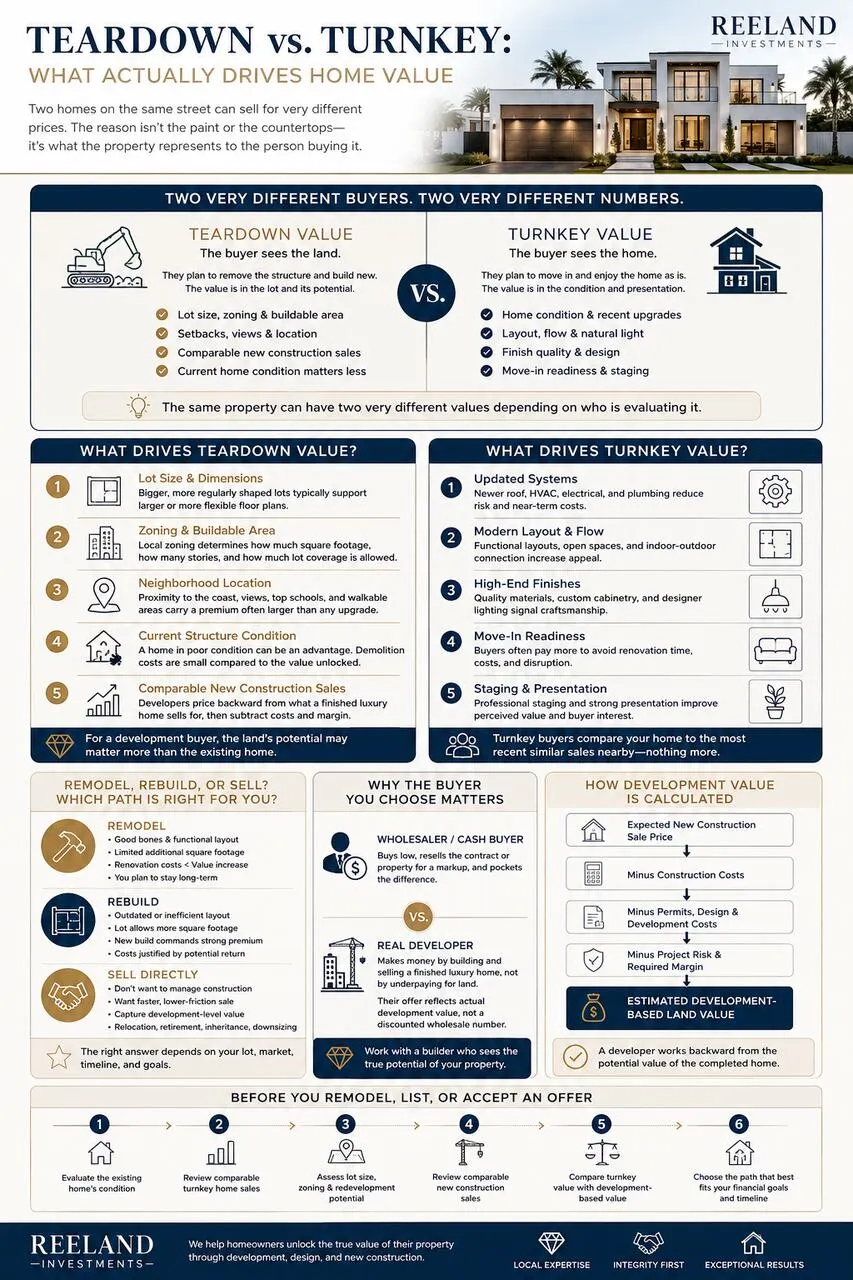
    When homeowners start thinking about selling, they almost always ask the same question first: "What's my house worth?" It feels like a simple question. It isn't. Two homes on the same street, built the same year, with nearly identical square footage, can sell for wildly different prices and the reason usually has nothing to do with paint color or countertops. It has to do with what the property represents to the person buying it.

    How Long Does It Take to Build a New Luxury Home

    That's the real divide in today's high-end real estate market: teardown value versus turnkey value. Understanding which one applies to your property and why is the single most important factor in deciding how, when, and to whom you should sell.

    Two Very Different Buyers, Two Very Different Numbers

    Two Very Different Buyers, Two Very Different Numbers - Reeland Investments

    Every property attracts one of two types of buyers, and each type is doing completely different math.

    The turnkey buyer is purchasing a lifestyle. They're evaluating finishes, layout, natural light, curb appeal, and how quickly they can move in without lifting a hammer. Their offer is anchored to comparable sales of similarly finished homes what real estate agents call "comps." If your home is updated, well-maintained, and move-in ready, this is the buyer pool you're competing in, and your home's condition directly determines your ceiling.

    The development buyer isn't evaluating your home at all. They're evaluating your lot. Square footage of the existing structure, kitchen finishes, even the age of the roof none of it matters much, because the plan is to remove the structure and build something new. What matters instead is lot size, zoning, setbacks, buildable square footage, views, and location. A worn-down 1962 ranch house can be worth more to this buyer than a beautifully renovated home next door, simply because of what the land underneath it can become.

    The mistake many homeowners make is pricing their property or evaluating an offer using only one of these lenses. If you own an older home on a desirable lot and you only compare yourself to other "as-is" fixer sales, you're almost certainly leaving money on the table. If you own a dated home and assume a full remodel is the only path to unlocking value, you may be ignoring a faster, cleaner option sitting in plain sight: selling directly to a developer who sees what you don't.

    What Actually Drives "Teardown" Value

    What Actually Drives "Teardown" Value - Reeland Investments

    Teardown value isn't about the house at all it's about everything the house is sitting on top of. When a developer evaluates a property for redevelopment, they're running through a fairly specific checklist:

    • Lot size and dimensions: Bigger, more regularly shaped lots typically support larger or more flexible floor plans.
    • Zoning and buildable area: Local zoning determines how much square footage, how many stories, and how much lot coverage is allowed. Two identically sized lots can have very different development potential depending on setback requirements and height limits.
    • Location within the neighborhood: Proximity to the coast, a view corridor, a top-rated school, or a walkable downtown core all carry a premium often a larger one than any interior upgrade could add.
    • Current structure condition: Ironically, a home in poor condition can be an advantage here. There's little sunk cost being "wasted" in a teardown, and demolition costs are relatively minor compared to the value being unlocked.
    • Comparable new construction sales: Developers price backward from what a finished luxury home sells for in that specific micro-neighborhood, then subtract construction costs and margin to arrive at a land value.

    This is why a homeowner will sometimes hear, almost in disbelief, that their "outdated" home is worth more than they expected. The house isn't being valued. The dirt is.

    What Actually Drives "Turnkey" Value

    What Actually Drives "Turnkey" Value - Reeland Investments

    Turnkey value works in the opposite direction it's built almost entirely on the condition and presentation of the existing structure.

    • Recent renovations and updated systems (roof, HVAC, electrical, plumbing) reduce a buyer's perceived risk and near-term costs.
    • Modern layout and flow matter more than raw square footage. Open-concept living, primary suites with private access, and functional indoor-outdoor connection all command a premium in luxury markets.
    • Finish quality stone surfaces, custom cabinetry, designer lighting signals craftsmanship and justifies a higher price per square foot.
    • Move-in readiness removes friction. A buyer who doesn't have to manage a renovation project is often willing to pay for that convenience.
    • Staging and presentation genuinely affect perceived value, even though they don't change the underlying structure.

    A turnkey buyer is comparing your home to the last five similar homes that sold nearby full stop. There's no discount for land potential and no premium for it either, because that buyer isn't planning to build anything.

    The Gap Between the Two and Why It's Often Bigger Than Homeowners Expect

    The Gap Between the Two and Why It's Often Bigger Than Homeowners Expect - Reeland Investments

    Here's where it gets interesting. On any given lot, the turnkey value and the teardown value are rarely the same number, and the gap between them can be substantial sometimes the difference between selling for a comfortable profit and leaving six or seven figures on the table.

    Consider an older home in a high-demand coastal or hillside neighborhood. On the open market, priced against other dated homes, it might attract offers in a fairly narrow, unremarkable range. But priced against what a developer could build and sell that same lot for as a brand-new luxury residence, the underlying land value can be dramatically higher. The home itself is almost incidental to that number.

    This is exactly why so many homeowners are surprised pleasantly when they get a development-based evaluation instead of a standard listing appraisal. It's not a trick or a sales tactic. It's simply a different, and often more accurate, way of measuring what a property is actually worth in a supply-constrained luxury market.

    Rebuild, Remodel, or Sell? A Practical Way to Decide

    Rebuild, Remodel, or Sell? A Practical Way to Decide - Reeland Investments

    If you're sitting on an older property, you generally have three paths, and each makes sense under different conditions.

    Remodel makes sense when the existing structure has good bones, the lot doesn't support significantly more square footage than what's already built, you plan to stay in the home long-term, and renovation costs stay well below the home's post-renovation value.

    Rebuild makes sense when the current floor plan is inefficient or outdated, the lot allows meaningfully more square footage than what exists today, and construction costs are clearly offset by the resale premium a new home would command.

    Sell directly makes sense when you don't want to manage a construction project yourself, you'd rather capture development-level value without the time, risk, and capital outlay of building, or your circumstances relocation, retirement, an inherited property, downsizing call for a faster, lower-friction transition.

    None of these is universally "right." The right answer depends on your lot, your local market, your timeline, and your appetite for managing a project. But too many homeowners only ever consider two of these three options, usually remodel or a standard sale, without ever getting a proper development-based evaluation to see what the third path is actually worth.

    Why the Buyer You Choose Matters As Much As the Price

    Why the Buyer You Choose Matters As Much As the Price - Reeland Investments

    If you determine your property leans toward teardown value, the next decision is just as important as the number itself: who you sell to.

    A traditional cash-buyer or wholesaler model is built on the same principle as a middleman in any industry buy low, resell the contract or the property to someone else for a markup, and pocket the difference. That structure depends on you accepting less than the property is worth, because the wholesaler isn't building anything; they're flipping the deal itself.

    A genuine developer operates differently, because the economics are different. A real luxury home builder Laguna Beach makes money by constructing and selling a finished home, not by underpaying for the land. That means the offer can and should reflect actual development value, not a discounted wholesale number. If you're comparing offers and want to sell my house fast without giving up the value your lot actually carries, the source of the offer matters just as much as the dollar figure attached to it.

    This is also where new construction homes come back into the picture, even for a seller. Every finished new construction home in your neighborhood is a data point. It tells you, concretely, what a developer is able to sell a home for once your lot has been transformed which is exactly the number a legitimate developer should be working backward from when they make you an offer, rather than lowballing based on the current condition of your house.

    The Bottom Line

    Teardown value and turnkey value aren't competing theories they're two different lenses that apply to two different kinds of properties, and sometimes to the very same property depending on who's looking at it. The homeowners who get the best outcomes are the ones who understand which lens applies to them before they list, remodel, or accept an offer.

    If your home is updated, modern, and move-in ready, you're playing the turnkey game, and your focus should be on presentation and timing relative to comparable sales. If you own an older home on a desirable lot, it's worth getting a development-based evaluation before assuming a standard sale or a full renovation is your only option. The gap between what your home is worth "as-is" and what your land is worth to the right buyer can be the most financially significant number in the entire decision.

    Frequently Asked Questions

    How do I know if my home is worth more as a teardown or as a turnkey sale?

    The clearest signal is the relationship between your lot's development potential and your home's current condition. If your lot allows for significantly more square footage than what's currently built, or sits in a location where new construction commands a strong premium, it's worth getting a development-based evaluation alongside a traditional market comparison before deciding.

    Will a developer really pay more than a standard cash buyer?

    It depends on the buyer. A wholesaler's business model depends on underpaying for your property so they can resell the contract for a markup. A legitimate developer's model is based on construction and resale, so a fair offer should be built from land and development value not a discounted, below-market number.

    Do I need to renovate my home before selling it for its land value?

    Generally, no. If a buyer intends to redevelop the site, the condition of the existing structure has little bearing on the offer, since the home will likely be removed. Spending money on cosmetic updates before a teardown sale is usually unnecessary.

    Is rebuilding always a better investment than remodeling?

    Not always. Rebuilding tends to make more financial sense when the lot supports meaningfully more square footage than currently exists and construction costs are clearly offset by the resulting resale value. If your lot is already built close to its maximum allowable size, a well-planned remodel may be the smarter move.

    How quickly can I sell if my property has development potential?

    Timelines vary by buyer, but a direct sale to a developer is often faster than a traditional listing, since there's no staging, showings, or financing contingencies involved. Some homeowners are able to close in a matter of weeks through a private, direct transaction, while others prefer a longer timeline to align with a move or other life event a serious developer should be able to work with either.

    General Discussion

  • How Long Does It Take to Build a New Luxury Home?
    D dylanjackson783

    Building a luxury home is one of the most exciting and most misunderstood parts of the real estate process. Buyers often assume a custom build follows the same rough timeline as a standard production home, only to discover that luxury construction operates on a completely different set of variables. Lot conditions, architectural complexity, custom finishes, and local permitting requirements all play a role in how long the process actually takes.

    If you're considering a custom build, working with a developer on a spec home, or simply trying to understand what "new construction" really involves, this guide breaks down the full timeline from empty lot to move-in day along with the factors that can speed things up or slow them down.

    How Long Does It Take to Build a New Luxury Home

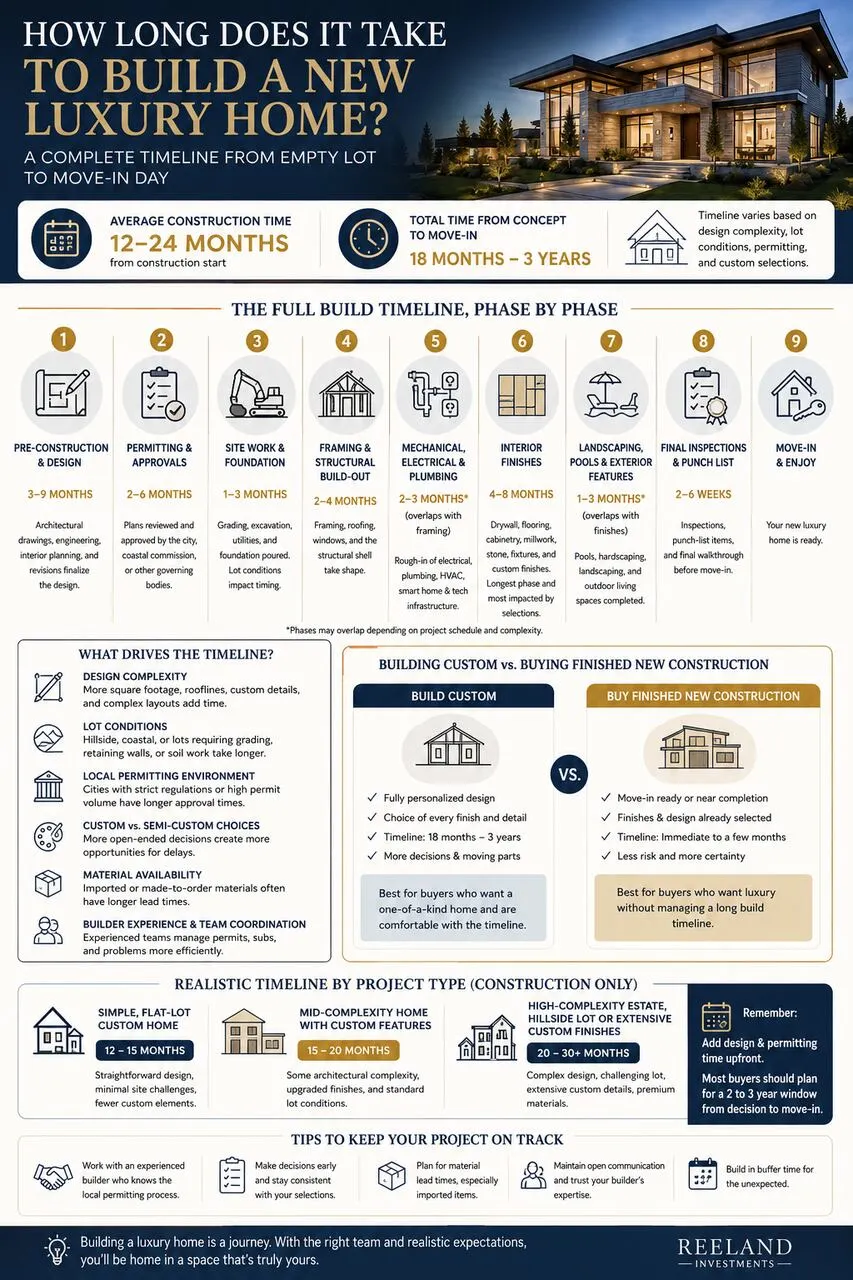
    On average, a luxury home takes 12 to 24 months to build from the day construction officially begins. Add in design, permitting, and site preparation, and the full process from initial concept to final walkthrough often spans 18 months to 3 years.

    That range is wide on purpose. A 3,500-square-foot modern home on a flat, previously developed lot with a straightforward design can move quickly. A 9,000-square-foot estate with a basement, pool, extensive custom millwork, and a hillside lot requiring geotechnical engineering will take considerably longer. The timeline is less about square footage alone and more about complexity, site conditions, and how many custom decisions are baked into the design.

    Breaking Down the Timeline, Phase by Phase

    Breaking Down the Timeline, Phase by Phase - Reeland Investments

    Pre-Construction and Design

    Before a single shovel hits the ground, there's a design phase that shapes everything downstream. This includes architectural drawings, structural engineering, interior design planning, and for custom builds multiple rounds of revisions between the homeowner, architect, and builder.

    For spec homes built by an experienced developer, this phase moves faster because the design is often finalized in-house before the property ever goes to market or before a buyer is involved. For fully custom homes, this stage can stretch longer as buyers weigh finishes, layouts, and structural choices.

    Permitting and Approvals

    This is the phase most buyers underestimate. Permitting timelines vary dramatically depending on the city, the complexity of the project, and whether the property sits in a coastal zone, hillside area, or historic district. Some municipalities process permits in a matter of weeks. Others, particularly in high-demand coastal and hillside markets, can take several months due to environmental review, coastal commission approval, or neighborhood design review boards.

    Experienced builders who have already navigated a city's permitting process and who maintain relationships with local planning departments tend to move through this stage more efficiently than first-time custom builders working with an unfamiliar team.

    Site Work and Foundation

    Once permits are approved, site work begins: grading, excavation, utility connections, and foundation pouring. Hillside lots, homes requiring extensive retaining walls, or properties needing soil remediation will take longer here. Flat, buildable lots move through this phase relatively quickly.

    Framing and Structural Build-Out

    This is when the home starts to take physical shape. Framing, roofing, and the structural shell are completed during this window. Larger homes, homes with unique rooflines, or those incorporating steel framing for large open spans will naturally take more time than a simpler structural design.

    Mechanical, Electrical, and Plumbing

    Once the structure is enclosed, the home is "roughed in" electrical wiring, plumbing lines, HVAC systems, and increasingly, smart home infrastructure are installed. Luxury homes often include more complex systems here: multi-zone HVAC, integrated audio/visual wiring, advanced security systems, and energy-efficient technology, all of which add time compared to a standard build.

    Interior Finishes

    This is typically the longest phase of a luxury build, and the one most affected by custom selections. Cabinetry, flooring, custom millwork, imported materials, designer lighting, and specialty finishes all require lead time and in many cases, these materials are made to order rather than pulled from stock. Supply chain delays for specialty imports (natural stone, custom hardware, high-end appliances) can meaningfully extend this phase.

    Landscaping, Pools, and Exterior Features

    Pools, outdoor kitchens, mature landscaping, and hardscaping are typically completed toward the end of the build, though excavation for pools sometimes begins earlier to run concurrently with interior work.

    Final Inspections and Walkthrough

    Before move-in, the home goes through final inspections, punch-list corrections, and a detailed walkthrough. Luxury builds often include a more thorough punch-list process given the number of custom details involved.

    What Actually Drives the Timeline

    What Actually Drives the Timeline - Reeland Investments

    • Size and complexity of the design: More square footage, more rooflines, more structural complexity all of it adds time. A simple rectangular footprint builds faster than a home with multiple wings, courtyards, or non-standard geometry.
    • Lot conditions: Hillside lots, coastal lots, and lots requiring significant grading or soil work almost always extend the timeline compared to flat, previously improved sites.
    • Local permitting environment: This is one of the biggest variables and the one buyers have the least control over. Cities with coastal commission review, strict design guidelines, or high permit volume tend to move slower than areas with more streamlined approval processes.
    • Custom vs. semi-custom decisions: The more decisions left open finishes, layouts, fixtures the more opportunities there are for delays while selections are finalized. Builders who present a curated, pre-selected package of high-end finishes can often move faster than fully open-ended custom projects.
    • Material availability: Imported stone, specialty tile, and custom cabinetry often carry longer lead times than domestic, in-stock materials. This has become an increasingly important factor in overall build timelines in recent years.
    • Builder experience and team coordination: An experienced team that has completed similar projects in the same market will typically move through each phase more predictably than a first-time custom build with a newly assembled team of subcontractors.

    Buying a Finished New Construction Home vs. Building Custom

    Buying a Finished New Construction Home vs. Building Custom - Reeland Investments

    Not every buyer wants to go through the full design-and-build process. For buyers who want a luxury home without managing an 18–24 month build, purchasing from an existing inventory of new construction homes for sale is often the more practical path. In this scenario, an experienced developer has already handled the design, permitting, and construction the buyer simply steps in near the end of the process or after completion, with far more certainty around timing and finishes.

    This is one of the biggest advantages of buying from a developer who builds on spec: the guesswork, the permitting delays, and the material sourcing have already been managed, and the buyer is purchasing a finished, move-in-ready product built to a high standard.

    Timing the Build Around an Existing Sale

    Timing the Build Around an Existing Sale - Reeland Investments

    For homeowners who need to coordinate their current home sale with a new build, timing becomes especially important. If you're planning to move into a custom home once construction wraps, you'll want to think carefully about when to list or when to work with a direct buyer so you're not carrying two properties longer than necessary. Many homeowners in this position start researching how to sell my house well before construction is finished, so the transition between homes lines up as closely as possible.

    Why the Right Builder Matters More Than the Blueprint

    Why the Right Builder Matters More Than the Blueprint - Reeland Investments

    Two builders can start with identical architectural plans and finish 6 months apart. The difference usually comes down to experience: how efficiently a team manages permitting relationships, how well they coordinate subcontractors, how they handle material lead times, and how proactively they solve problems before those problems cause delays.

    This is why buyers and sellers alike benefit from working with established luxury home builders San Clemente who have a proven track record in the specific market not just general contracting experience, but a documented history of completing high-end projects on time and to spec in that particular city or neighborhood. A builder who already understands local permitting nuances, has relationships with quality subcontractors, and has sourced high-end materials before is simply going to move faster and more predictably than a team building in unfamiliar territory.

    Setting Realistic Expectations

    Setting Realistic Expectations - Reeland Investments

    If you're planning a custom luxury build, here's a realistic framework:

    • Simple, flat-lot custom home: 12–15 months of construction
    • Mid-complexity home with some custom features: 15–20 months
    • High-complexity estate, hillside lot, or extensive custom finishes: 20–30+ months

    Add design and permitting time on the front end, and most buyers should plan for a 2 to 3 year window from the initial decision to build to the day they move in with construction itself representing roughly 12 to 24 months of that timeline.

    Final Thoughts

    Building a luxury home is a significant undertaking, but understanding the phases and the variables that influence each one makes the process far less unpredictable. Whether you're planning a fully custom build, purchasing a home already under construction, or weighing the decision to build versus buy, having a clear picture of the timeline helps you plan every other part of the transition, from financing to moving logistics to the sale of your current property.

    Frequently Asked Questions

    What is the average timeline to build a luxury home from start to finish?

    Most luxury homes take 12 to 24 months to construct once permits are approved, with an additional 6 to 12 months typically needed for design and permitting beforehand bringing the full process to roughly 18 months to 3 years.

    What's the biggest factor that delays luxury home construction?

    Permitting is usually the least predictable variable, especially in coastal, hillside, or historic districts with additional review requirements. Custom material lead times and design changes mid-build are the next most common sources of delay.

    Is it faster to buy an already-built luxury home than to build custom?

    Yes. Purchasing a completed or near-completed home eliminates the design, permitting, and construction timeline entirely, since the builder has already managed that process on their own schedule.

    Can I speed up the construction timeline?

    Working with an experienced, established builder, finalizing design decisions early, and choosing readily available materials over custom-imported options are the most effective ways to shorten the overall timeline.

    How far in advance should I plan if I want to move in by a specific date?

    Given design, permitting, and construction combined, it's wise to start the process at least 24 to 30 months before your target move-in date, with extra buffer built in for hillside lots, coastal permitting, or highly customized finishes.

    General Discussion

  • What is Real Estate Investment Advisory, and Do You Need It?
    D dylanjackson783

    What is Real Estate Investment Advisory, and Do You Need It?

    Real estate is often described as one of the most reliable ways to build long-term wealth, but "reliable" doesn't mean "simple." Between financing decisions, market timing, property selection, renovation costs, and exit strategy, even experienced investors can find themselves making choices based on gut instinct rather than data. That's where real estate investment advisory comes in.
    What is Real Estate Investment Advisory, and Do You Need It

    If you've ever wondered whether you need professional guidance before buying, renovating, or selling a property, this article breaks down exactly what investment advisory means, who it's for, how it works in practice, and how it differs from working with a traditional agent or a quick-cash buyer.

    Defining Real Estate Investment Advisory

    Defining Real Estate Investment Advisory - Reeland Investments

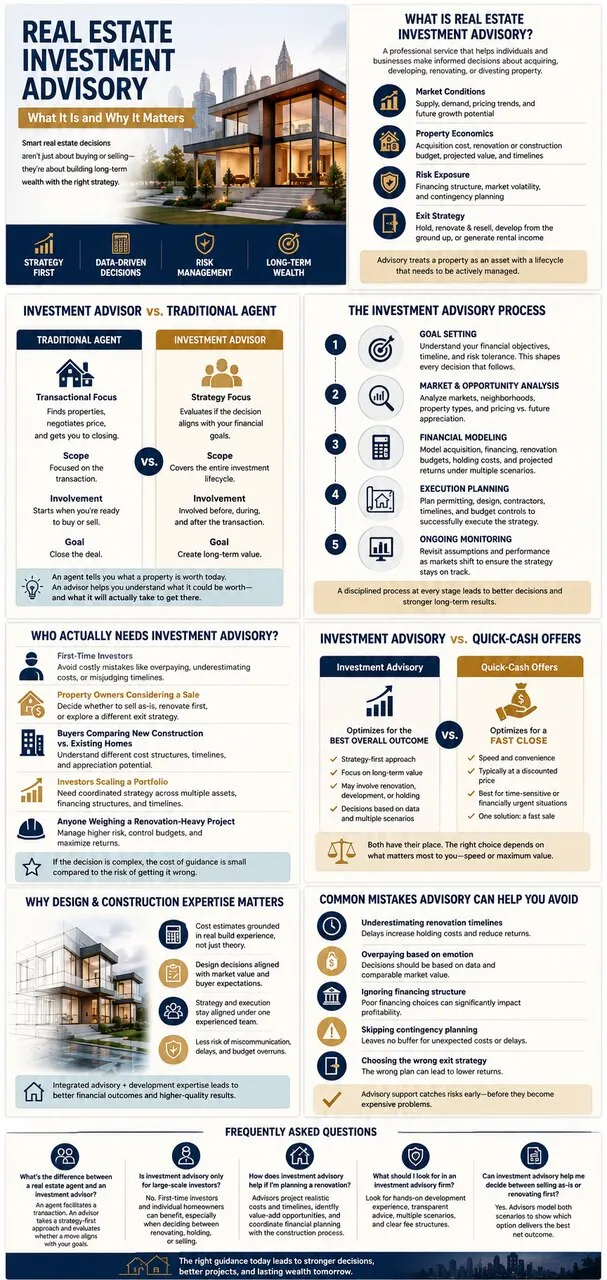
    Real estate investment advisory is a professional service that helps individuals and businesses make informed decisions about acquiring, developing, renovating, or divesting property. Unlike a standard real estate transaction, where the primary goal is simply to buy or sell, advisory work is centered on strategy. It asks a bigger question: does this decision actually align with your financial goals?

    An advisor typically evaluates:

    • Market conditions: supply, demand, pricing trends, and future growth potential in a given segment
    • Property-level economics: acquisition cost, renovation or construction budget, projected value after improvement, and realistic timelines
    • Risk exposure: financing structure, market volatility, and contingency planning
    • Exit strategy: whether the plan is to hold, renovate and resell, develop from the ground up, or generate rental income

    In short, investment advisory treats a property not just as a place to live or a transaction to close, but as an asset with a lifecycle that needs to be actively managed. That lifecycle view is what separates advisory work from a one-time transactional relationship. A good advisor is thinking several steps ahead: not just "can this deal close," but "will this decision still look smart in three years."

    How It Differs From a Traditional Real Estate Agent

    How It Differs From a Traditional Real Estate Agent - Reeland Investments

    A traditional agent's job is largely transactional. They help you find a property, negotiate a price, and get you to closing. That's valuable, but it's a narrow slice of what a serious investment decision requires.

    An investment advisor goes further. They're often involved before a property is even identified, helping define what type of asset makes sense given your capital, timeline, and risk tolerance. They stay involved after closing too, particularly when renovation, repositioning, or new construction is part of the plan.

    This distinction matters most when the strategy involves more than a simple resale. Someone planning a full renovation or ground-up build needs a very different kind of support than someone doing a straightforward home purchase, because the number of variables permitting, construction costs, design decisions, contractor coordination expands significantly. An agent can tell you what a property is worth today. An advisor helps you understand what it could be worth, and what it will actually take to get there.

    The Advisory Process, Step by Step

    The Advisory Process, Step by Step - Reeland Investments

    While every firm operates a little differently, most credible investment advisory relationships follow a similar arc:

    Goal setting

    Before any property is discussed, a good advisor will want to understand your financial objectives, timeline, and risk tolerance. Are you looking for steady rental income, a short-term value-add project, or a long-term hold? The answer shapes everything that follows.

    Market and opportunity analysis

    Next comes a deeper look at where opportunity actually exists. This might mean comparing neighborhoods, property types, or asset classes, and weighing current pricing against projected appreciation.

    Financial modeling

    This is where theory meets numbers. Acquisition costs, financing terms, renovation or construction budgets, holding costs, and projected resale or rental value all get modeled out, usually under multiple scenarios rather than a single best-case projection.

    Execution planning

    If the plan involves renovation or new construction, this stage covers permitting timelines, contractor selection, design decisions, and budget controls. This is often where projects succeed or fail, since even a well-researched deal can underperform if execution isn't managed carefully.

    Ongoing monitoring

    Advisory doesn't necessarily end at closing or at project completion. Markets shift, and a good advisor will revisit assumptions periodically to confirm the original strategy still holds up.

    Understanding this process helps clarify why advisory services are valued differently than a single transaction fee. You're not just paying for access to a property. You're paying for a structured decision-making process at every stage.

    Who Actually Needs Investment Advisory?

    Who Actually Needs Investment Advisory - Reeland Investments

    Not every real estate decision requires formal advisory support. But there are specific situations where it makes a meaningful difference:

    First-time investors

    If you're new to real estate investment, advisory guidance helps you avoid the most common and costly mistakes: overpaying for a property, underestimating renovation costs, or misjudging how long a project will actually take to complete. Many first-time investors also underestimate holding costs, which can quietly erode returns even on an otherwise solid deal.

    Property owners considering a sale

    If you're thinking, "I want to sell my home Newport Beach," but you're unsure whether selling as-is, renovating first, or exploring a different exit strategy makes more financial sense, an advisor can model out each scenario so you're deciding based on numbers rather than guesswork. In many cases, a modest, well-targeted renovation can meaningfully increase net proceeds, but only if the cost and timeline are managed correctly.

    Buyers comparing new construction against existing homes

    Anyone weighing new construction homes for sale against renovation or resale options benefits from advisory input, since new builds come with a different cost structure, timeline, and appreciation profile than existing homes. New construction often carries a premium up front but can offer lower near-term maintenance costs and more predictable performance, which matters for buyers thinking about resale value down the line.

    Investors scaling a portfolio

    Once you move beyond a single property, advisory support becomes less of a convenience and more of a necessity. Managing multiple assets, financing structures, and timelines without a coordinated strategy is where most portfolio-level mistakes happen. What works for one property doesn't always scale cleanly to five.

    Anyone weighing a renovation-heavy project

    Full-scale renovations and developments carry significantly more risk than a standard purchase. Budget overruns, permitting delays, and design changes can quickly erode projected returns if there isn't a disciplined plan in place from the start. Advisory support here often means the difference between a project that stays on budget and one that quietly bleeds margin.

    What a Good Advisory Relationship Looks Like

    What a Good Advisory Relationship Looks Like - Reeland Investments

    Quality investment advisory isn't about being sold a property. It's about getting honest, numbers-driven input, even when that input means recommending against a deal. A good advisor should be able to walk you through:

    • Realistic cost projections, including contingencies for the unexpected
    • Comparable market data that supports (or challenges) the proposed valuation
    • A clear timeline from acquisition to completion or resale
    • Multiple scenarios, not just the best-case outcome
    • A transparent explanation of fees and how they're structured

    This is especially important when development or construction is involved. Firms that combine investment advisory with licensed development and construction expertise, rather than outsourcing that piece to a third party, tend to give more grounded guidance, because they understand firsthand what a renovation or build actually costs and how long it actually takes. There's a meaningful difference between an advisor who has only studied a market and one who has personally managed the permitting delays, material cost swings, and contractor scheduling that come with real projects.

    Investment Advisory vs. Quick-Cash Offers

    Investment Advisory vs. Quick-Cash Offers - Reeland Investments

    It's worth drawing a clear line here. If you've searched anything related to selling your home quickly, you've likely encountered cash-buyer companies promising a fast, no-hassle transaction. These offers can be appropriate in certain situations, particularly when speed matters more than maximizing value, such as during a time-sensitive relocation or financial hardship.

    But a quick-cash offer and investment advisory are solving for different things. A cash buyer is optimizing for a fast close, typically at a discounted price that reflects the convenience and speed of the transaction. An advisor is optimizing for the best overall outcome, even if that means a longer timeline, a renovation phase, or a different strategy than an outright sale. Neither approach is inherently better; they simply serve different priorities. Understanding which outcome actually matters to you, speed versus maximum value, is the first step in deciding whether advisory support, a direct sale, or something in between is the right move.

    Why Design and Construction Expertise Matters in Advisory

    Why Design and Construction Expertise Matters in Advisory - Reeland Investments

    Investment strategy and physical execution are often treated as separate disciplines, but in practice, they're deeply connected. A renovation plan that looks great on paper can fall apart if the construction team underestimates cost or timeline. Similarly, advisors without hands-on development experience may not fully account for the real-world constraints of permitting, structural work, or design execution.

    This is one of the reasons working with an established, licensed firm can be an advantage over piecing together separate advisors, agents, and contractors. When the same team is responsible for both the strategic plan and the physical execution, there's far less risk of the two being misaligned. Cost estimates are grounded in actual build experience, not theoretical projections, and design decisions, finishes, layouts, and material choices, are made with resale value and market positioning in mind from day one. This kind of integrated approach is common among luxury home contractors who also provide advisory services, since it allows a single team to control both the financial strategy and the quality of execution, rather than handing a project off between disconnected parties.

    Common Mistakes Investment Advisory Can Help You Avoid

    Even experienced buyers and sellers make predictable mistakes when navigating real estate decisions without structured guidance. A few of the most common include:

    • Underestimating renovation timelines, which increases holding costs and delays returns
    • Overpaying based on emotional attachment rather than comparable market data
    • Ignoring financing structure, which can significantly affect overall project profitability
    • Skipping contingency planning, leaving no buffer for unexpected costs or delays
    • Choosing the wrong exit strategy, such as renovating for resale when holding for rental income would have performed better, or vice versa

    Advisory support exists specifically to catch these issues before they become expensive problems.

    Making the Decision: Do You Need Advisory Support?

    If your real estate goals are straightforward, buying a primary residence with no renovation plans, for example, a traditional agent may be all you need. But if any of the following apply to your situation, investment advisory is worth serious consideration:

    • You're evaluating a property with renovation or development potential
    • You're unsure whether to sell, hold, or improve a property you already own
    • You're comparing multiple types of opportunities and need help weighing risk against return
    • You're new to real estate investment and want to avoid costly early mistakes
    • You're planning a project significant enough that a miscalculation could meaningfully affect your returns

    In each of these cases, the cost of professional guidance is typically small relative to the financial risk of getting a major decision wrong.

    Final Thoughts

    Real estate investment advisory exists to bring discipline and clarity to decisions that often get made emotionally or reactively. Whether you're buying, renovating, developing, or selling, having someone in your corner who understands both the numbers and the practical realities of construction and design can be the difference between a project that performs and one that underdelivers.

    The right advisory relationship doesn't just help you close a deal. It helps you make sure the deal was the right one to begin with, and that every decision along the way is grounded in realistic numbers rather than optimism.

    Frequently Asked Questions

    What's the difference between a real estate agent and an investment advisor?

    An agent primarily helps facilitate a transaction, finding a property or a buyer and negotiating terms. An investment advisor takes a broader, strategy-first approach, evaluating whether a given move actually fits your financial goals before, during, and after the transaction itself.

    Is investment advisory only for large-scale investors?

    No. While it's essential for anyone scaling a portfolio, first-time investors and individual homeowners can also benefit, particularly when deciding between renovating, holding, or selling a property.

    How does investment advisory help if I'm planning a renovation?

    An advisor can help project realistic costs and timelines, identify where a renovation is likely to add real value versus where it won't pay off, and coordinate the financial plan with the construction process to avoid budget overruns.

    What should I look for in an investment advisory firm?

    Look for firms with hands-on development and construction experience, not just theoretical market knowledge. Transparent, numbers-based guidance and a willingness to present multiple scenarios, rather than just the most favorable one, are also strong signs of a trustworthy advisor.

    Can investment advisory help me decide between selling as-is or renovating first?

    Yes. This is one of the most common questions advisors help answer, since the right choice depends on current market conditions, renovation costs, and how much value an improvement is likely to add before resale.

    General Discussion

  • New Construction vs Existing Luxury Homes: Which Is the Better Investment?
    D dylanjackson783

    When purchasing a luxury property, one of the most important decisions buyers face is whether to invest in a newly constructed home or an existing luxury residence. Both options offer unique advantages, but the right choice depends on your financial goals, lifestyle preferences, and long-term investment strategy.

    Luxury real estate has long been considered a stable asset for wealth preservation and appreciation. However, the characteristics of new construction and existing homes can significantly impact future value, maintenance costs, and overall return on investment.

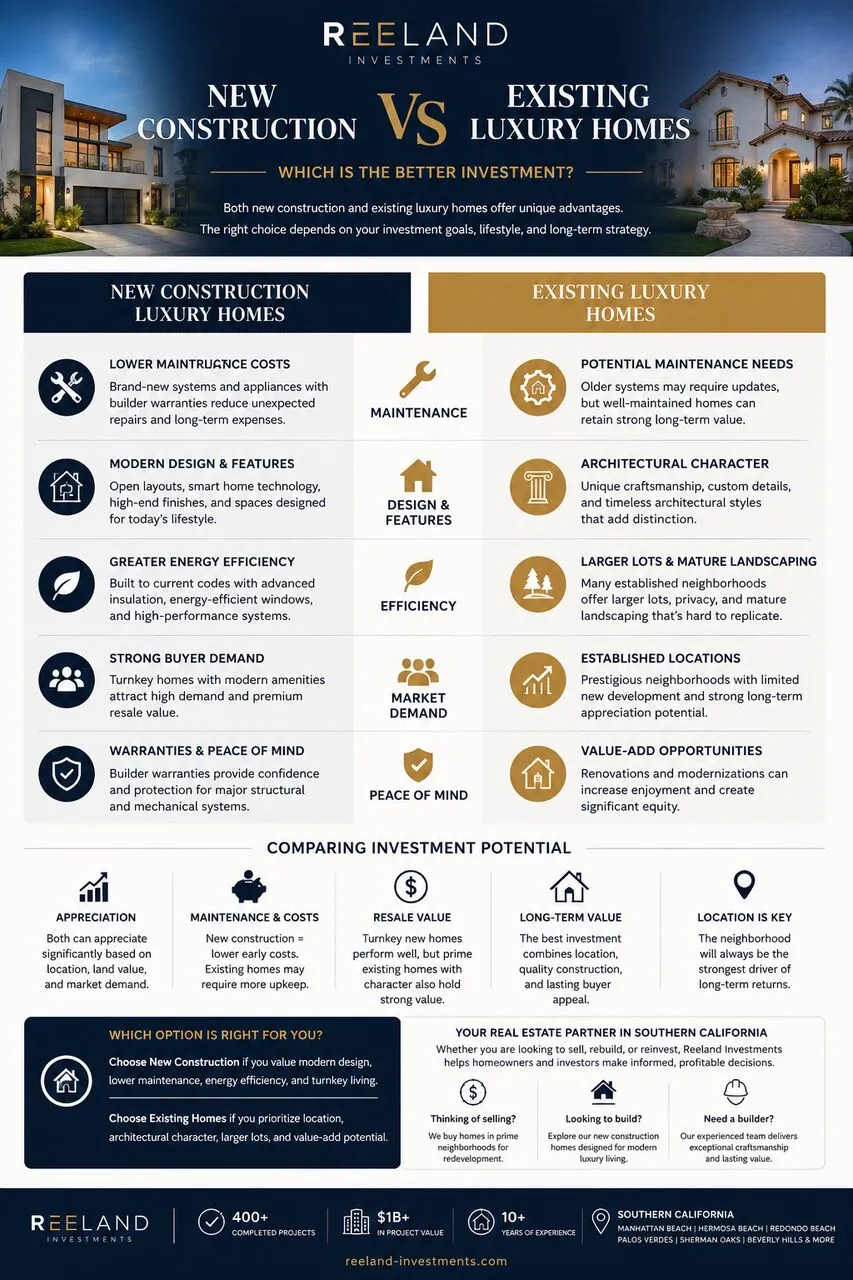
    New Construction vs Existing Luxury Homes Which Is the Better Investment - Reeland Investments

    In this guide, we'll explore the key differences between new construction and existing luxury homes to help you determine which option is the better investment.

    Understanding New Construction Luxury Homes

    Understanding New Construction Luxury Homes - Reeland Investments

    New construction luxury homes are properties built using modern design principles, contemporary materials, and the latest construction technologies. These homes are often located in highly desirable neighborhoods and feature open floor plans, energy-efficient systems, smart home integration, and premium finishes.

    Because everything is brand new, buyers typically enjoy a move-in-ready experience without the need for immediate repairs or renovations.

    Benefits of New Construction Homes

    Lower Maintenance Costs

    One of the biggest advantages of purchasing a newly built luxury home is reduced maintenance. Major systems such as roofing, plumbing, electrical, HVAC, and appliances are brand new and often covered by builder warranties.

    This can result in significant savings during the first several years of ownership.

    Modern Design and Features

    Luxury buyers increasingly prioritize features such as smart home automation, energy efficiency, home offices, wellness spaces, and seamless indoor-outdoor living. New construction homes are designed to meet these evolving expectations.

    Modern layouts also tend to maximize natural light, functionality, and overall livability.

    Greater Energy Efficiency

    New homes are built according to current building codes and often incorporate advanced insulation, energy-efficient windows, solar readiness, and high-performance HVAC systems.

    These upgrades can reduce utility expenses while enhancing long-term property value.

    Strong Buyer Demand

    Many luxury buyers prefer turnkey properties that require little or no renovation. As a result, high-quality new construction homes often attract strong demand and premium resale values.

    Understanding Existing Luxury Homes

    Understanding Existing Luxury Homes - Reeland Investments

    Existing luxury homes are properties that have been previously owned and may range from relatively new residences to historic estates with decades of architectural significance.

    Many established luxury neighborhoods feature homes with larger lots, mature landscaping, and unique architectural character that cannot easily be replicated today.

    Benefits of Existing Luxury Homes

    Established Locations

    Some of the most prestigious neighborhoods have limited opportunities for new development. Existing homes provide access to mature communities, prime locations, and highly sought-after school districts.

    Location remains one of the strongest drivers of long-term real estate appreciation.

    Architectural Character

    Older luxury homes often feature craftsmanship, custom details, and architectural styles that distinguish them from newer developments.

    For buyers who value uniqueness and history, existing properties can offer a level of character that modern construction may not always provide.

    Potential Value-Add Opportunities

    An existing luxury property may offer opportunities for renovation or modernization. Strategic improvements can increase both enjoyment and future resale value.

    In some cases, buyers can acquire a property below replacement cost and create significant equity through upgrades.

    Larger Lots

    Many older luxury neighborhoods were developed when land was more abundant. As a result, existing homes often sit on larger lots than newer properties in comparable locations.

    Larger parcels can enhance privacy, outdoor living potential, and future redevelopment opportunities.

    Comparing Investment Potential

    Comparing Investment Potential - Reeland Investments

    Appreciation

    Both new construction and existing luxury homes can appreciate over time. However, appreciation is often influenced more by location, land value, and market demand than by the age of the home itself.

    New construction properties may command higher initial prices due to modern features, while existing homes in prime locations may benefit from land scarcity and neighborhood prestige.

    Maintenance and Ownership Costs

    New construction homes generally have lower maintenance expenses during the early years of ownership. Existing homes may require updates to aging systems, roofing, plumbing, or other infrastructure.

    Buyers should carefully evaluate potential maintenance costs when comparing investment opportunities.

    Resale Value

    Luxury buyers increasingly seek move-in-ready homes with contemporary finishes and technology. New construction homes often perform well in this environment.

    However, well-maintained existing homes in premier neighborhoods can also generate strong resale demand, particularly when architectural character and location are difficult to replicate.

    Long-Term Value

    The best investment is often the property that combines excellent location, quality construction, and enduring buyer appeal.

    A thoughtfully designed new construction home in a desirable neighborhood can offer exceptional long-term performance. Likewise, an existing luxury property with strong land value and renovation potential can create substantial wealth over time.

    Which Option Is Right for You?

    If you value modern design, lower maintenance costs, energy efficiency, and turnkey living, a new construction luxury home may be the better investment.

    If you prioritize location, architectural character, larger lots, and value-add opportunities, an existing luxury home may provide greater long-term potential.

    Ultimately, successful luxury real estate investing depends on evaluating the property's location, construction quality, market demand, and future growth prospects rather than focusing solely on whether the home is new or existing.

    For homeowners exploring options in premium neighborhoods, the decision often goes beyond just buying a property. Many start by asking whether they should sell my house, especially when the existing home no longer matches their lifestyle or long-term goals. In such cases, understanding redevelopment potential becomes important, particularly in areas where demand for luxury home construction continues to grow. This is where experienced luxury home builders in manhattan beach play a key role, helping transform older properties into modern residences that better align with current market expectations. Whether the goal is to sell, rebuild, or reinvest, evaluating both resale value and new construction potential ensures a more informed and profitable real estate decision.

    Conclusion

    There is no universal answer to whether new construction or existing luxury homes are the better investment. Each offers distinct advantages that appeal to different buyers and investors.

    For those seeking convenience, efficiency, and modern living, new construction often delivers exceptional value. For buyers focused on location, character, and long-term appreciation opportunities, existing luxury homes can be equally compelling.

    The most successful investments are those that align with your financial objectives, lifestyle needs, and long-term vision for ownership.

    Frequently Asked Questions (FAQs)

    Are new construction luxury homes a good investment?

    Yes. New construction luxury homes often offer lower maintenance costs, modern amenities, energy efficiency, and strong resale appeal, making them attractive long-term investments.

    Do existing luxury homes appreciate faster than new homes?

    Appreciation depends primarily on location, market demand, and land value. In highly desirable neighborhoods, existing luxury homes may experience strong appreciation due to limited inventory and land scarcity.

    Which type of luxury home has lower maintenance costs?

    New construction homes generally have lower maintenance expenses because major systems and appliances are brand new and frequently covered by warranties.

    Is it better to renovate an existing luxury home or buy a new one?

    The answer depends on your goals. Renovating an existing home may create additional equity, while purchasing a new home offers convenience and reduced maintenance responsibilities.

    What should investors focus on when evaluating luxury properties?

    Investors should consider location, land value, construction quality, neighborhood demand, future development trends, and potential resale value rather than focusing only on the home's age.

    Do new luxury homes have better energy efficiency?

    Yes. Most newly constructed luxury homes incorporate modern building standards, energy-efficient systems, smart home technology, and sustainable design features that reduce operating costs.

    General Discussion
  • Login

  • Don't have an account? Register

  • Login or register to search.
  • First post
    Last post
0
  • Categories
  • Recent
  • Tags
  • Popular
  • Users
  • Groups